
Metadata Resources
The resources below provide an introduction to metadata and different metadata annotation levels, and include explanations of why researchers should annotate their studies at each level.
Common Data Elements
Overview
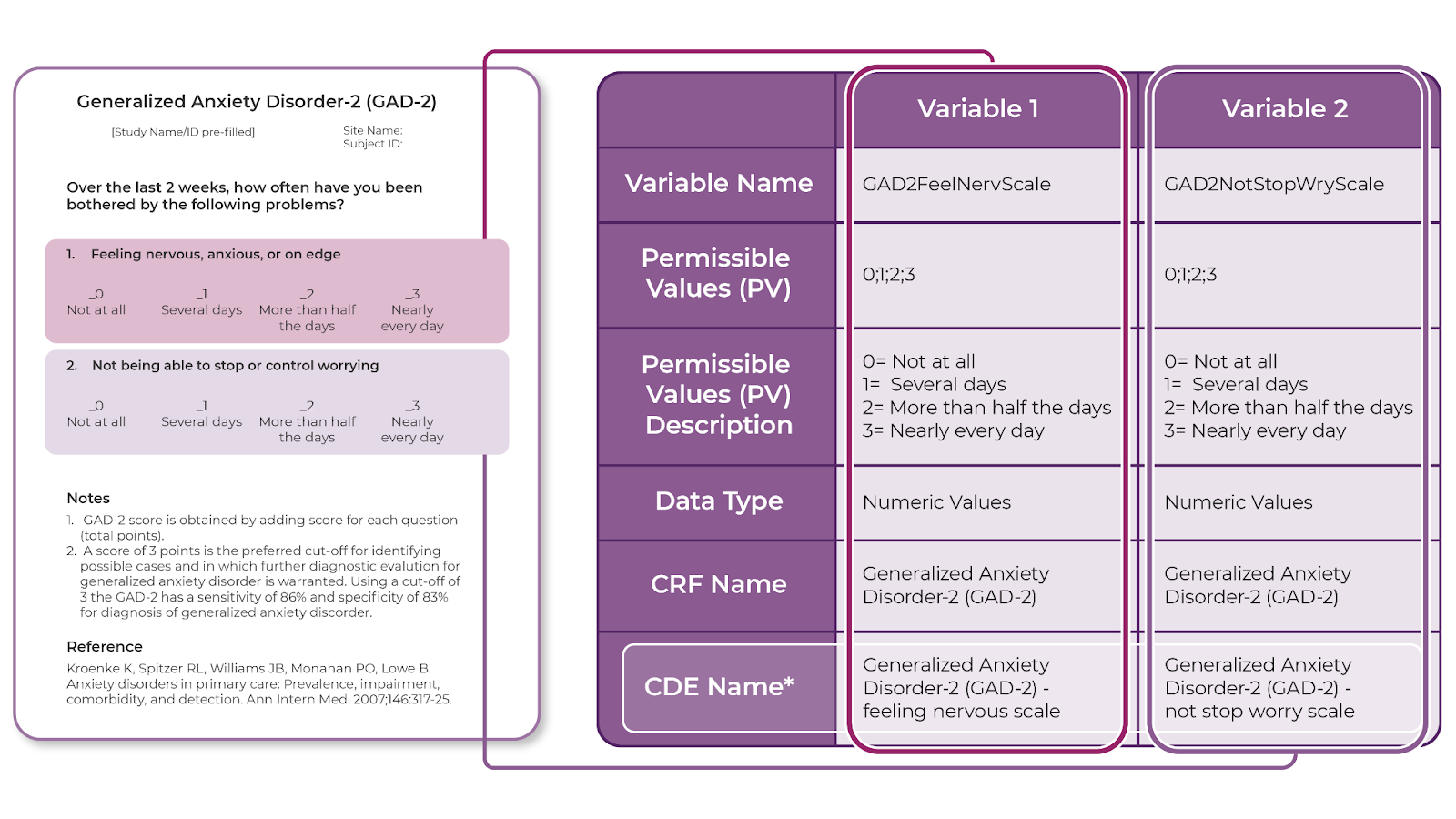
Common Data Elements (CDEs) are precisely defined and standardized measures, paired with allowable responses or acceptable data types, used systematically across different sites, studies, or clinical trials to ensure consistent data collection. CDEs may be grouped or bundled into questionnaires or CRFs for research or clinical purposes. By ensuring consistent data collection, CDEs act as a foundational template for data recording and collection and downstream data harmonization efforts.
It is important to distinguish between these concepts:
- Validated Questionnaires: These are specific, formally validated question sets measuring a particular concept of interest, and may also be referred to as CRFs. For example, the PHQ-9 (Patient Health Questionnaire-9) is a validated questionnaire with nine questions (CDEs) measuring depression severity. When using validated questionnaires, it is crucial to administer all questions exactly as specified to maintain instrument validity.
- Case Report Forms (CRFs): In broader usage, CRFs are more expansive than a single questionnaire and may include multiple questionnaires administered at the same time. While validated CRF questionnaires must remain intact for validity, individual CDEs from other CRFs can still retain their meaning, even if used separately in different parts of the data collection process.
- Custom Questionnaires: These are unvalidated question sets developed for specific studies. Some items on a custom questionnaire might resemble validated questionnaire CDEs but not strictly adhere to the validated CDE specification. Others might be original items authored by the study team.
Different organizations and programs, including the NIH and the HEAL Initiative, define their own CDEs. These are developed by subject matter experts who examine CDEs used by similar past studies, identify precise question text and measurement scales, and validate their CDEs by testing whether they accurately capture the variables of interest. The HEAL CDE team (heal_cde@hsc.utah.edu) or CDE experts at the NIH or your organization can assist with planning for CDE use during data collection. Some validated instruments may be subject to copyright or other licensing restrictions, and in such cases, a review copy might be available to aid in the decision to license them.
The HEAL Initiative's clinical pain research studies must collect a core group of CDEs to measure the most important pain domains. Depending on the research study's purposes, they may also use supplemental CDEs/CRFs. All HEAL studies collecting data from human participants should search for applicable CDEs in the HEAL CDE repository.
CDEs Submission Process
Studies using any CDEs, HEAL-approved or otherwise, must report which CDEs they use to the HEAL CDE team at heal_cde@hsc.utah.edu. For more information, please refer to the HEAL CDE program website or contact the HEAL CDE team at heal_cde@hsc.utah.edu.