Metadata Resources
The resources below provide an introduction to metadata and different metadata annotation levels, and include explanations of why researchers should annotate their studies at each level.
Study-level Metadata
Overview
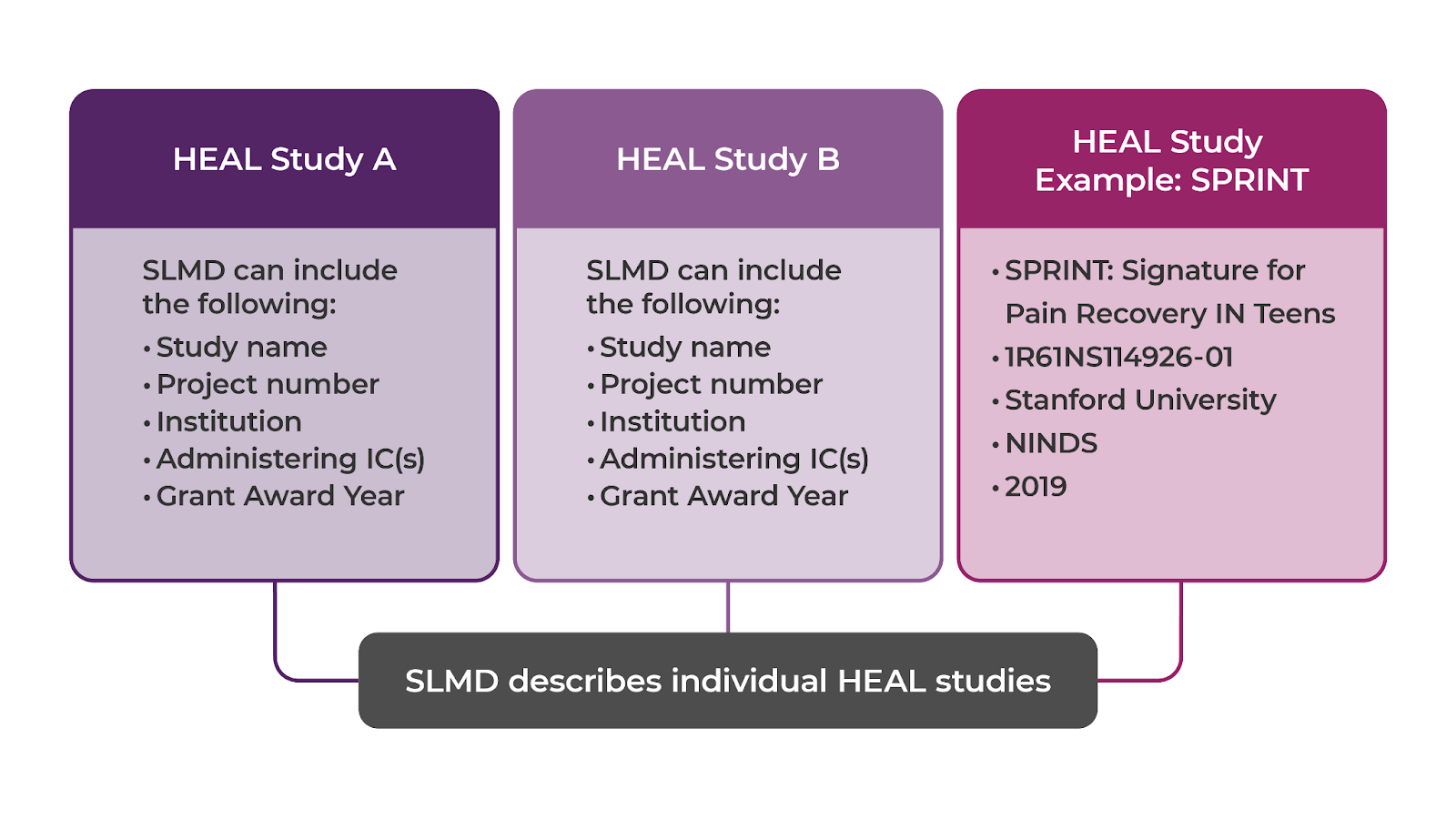
For the NIH HEAL Initiative®, SLMD is the highest level of metadata and includes information like a study's name, description, unique identifier, and investigators. This metadata enables discovery of datasets generated by HEAL funded studies on the HEAL Platform. Although the actual data files are stored in data repositories, users can search for and find HEAL study datasets on the HEAL Platform.
The NIH requires most HEAL Investigators to provide SLMD via a CEDAR form. Complete this form within one year of receiving your award. Additionally, update the SLMD as needed at the study’s completion and/or when releasing study data.
How to submit SLMD via the CEDAR Form
To submit SLMD, register your study on the HEAL Data Platform. HEAL Platform registration is a simple, three step process:
- Request access to register your study.
- Create a CEDAR account. It is best practice to use the same email address as in in Step 1.
- Register your study on the HEAL Data Platform.
After registering on the HEAL Platform, a CEDAR SLMD form for your study is automatically created.
To fill out and submit your CEDAR SLMD form, follow the documentation here or follow along with the tutorial playlist. To update SLMD after submitting the CEDAR SLMD form, contact the HEAL Platform.
To request support, please contact the HEAL Platform team.
For further registration information, please see the HEAL Fresh FAIR webinar on Platform registration and the Platform registration tutorial videos.
Resources
- Checklist for HEAL-compliant Data (see step "Complete Your Study-Level Metadata Form")
- Study-level metadata submission webinar recording
- CEDAR SLMD form tutorial
- CEDAR SLMD form documentation
- HEAL Study-Level Core Metadata v1.0.0 List of Fields - Describes all HEAL's SLMD CEDAR form fields. These metadata fields were carefully selected to empower HEAL data discoverability on the Platform.
- SLMD FAQs